
Test drives are useful, but they are only as good as the questions you bring to them. A twenty-minute loop around the dealership, with a salesperson in the passenger seat and a pre-planned route on smooth roads, will tell you almost nothing about what the car will feel like on a cold Tuesday morning when you are running late and the battery is at forty percent.
Owen Barrett has a short list of questions he recommends every reader answer — or at least think through — before they ever sit in the driver's seat. These are not questions about zero-to-sixty times or battery chemistry. They are questions about your parking spot, your weekly errands, your car seats, and your tolerance for minor inconvenience. Answer them honestly, and you will know more about whether an EV fits your life than any spec sheet can teach you.
Where will this car sleep, and how will it eat?
This is the first question, and for many people, it is the only one that matters. The answer determines nearly everything else.
If you have a garage or driveway with access to an outlet or a dedicated charger, an EV becomes a genuine convenience. You plug in at night. You wake up to a full battery. You never visit a gas station in your daily life.
If you park on the street or in an apartment lot without charging, the equation changes. You will rely on public chargers, workplace plugs, or a combination of both. That can work, but it requires more planning and more time than home charging does. The question to ask yourself is not "Can I make this work?" but "Will this arrangement still feel fine to me in February, in the rain, when I am tired?"
Do not guess. Picture your actual week. Picture where the car will be parked and for how long. If you cannot clearly visualize the car charging during your normal routine, the fit is uncertain.
How many miles do I actually drive on a normal day?
The range number on the window sticker is an answer to a question most people do not ask. The question you should ask is much simpler: how far do I go on an ordinary day, and how far on the longest day I actually drive more than twice a year?
For most American households, the answer to the first part is under forty miles. The answer to the second part might be two hundred miles for a holiday trip. An EV with modest range can cover the daily driving effortlessly but might require planning for the long trip. That is a reasonable tradeoff for some people and a dealbreaker for others.
The honest move is to look at your actual driving log, not your imagined one. A car that fits your Tuesday is more valuable than a car that fits a road trip you might take someday.
What gear needs to come with me?
Electric vehicles are test-driven empty and sold with cargo specs in liters. You will not live with them empty.
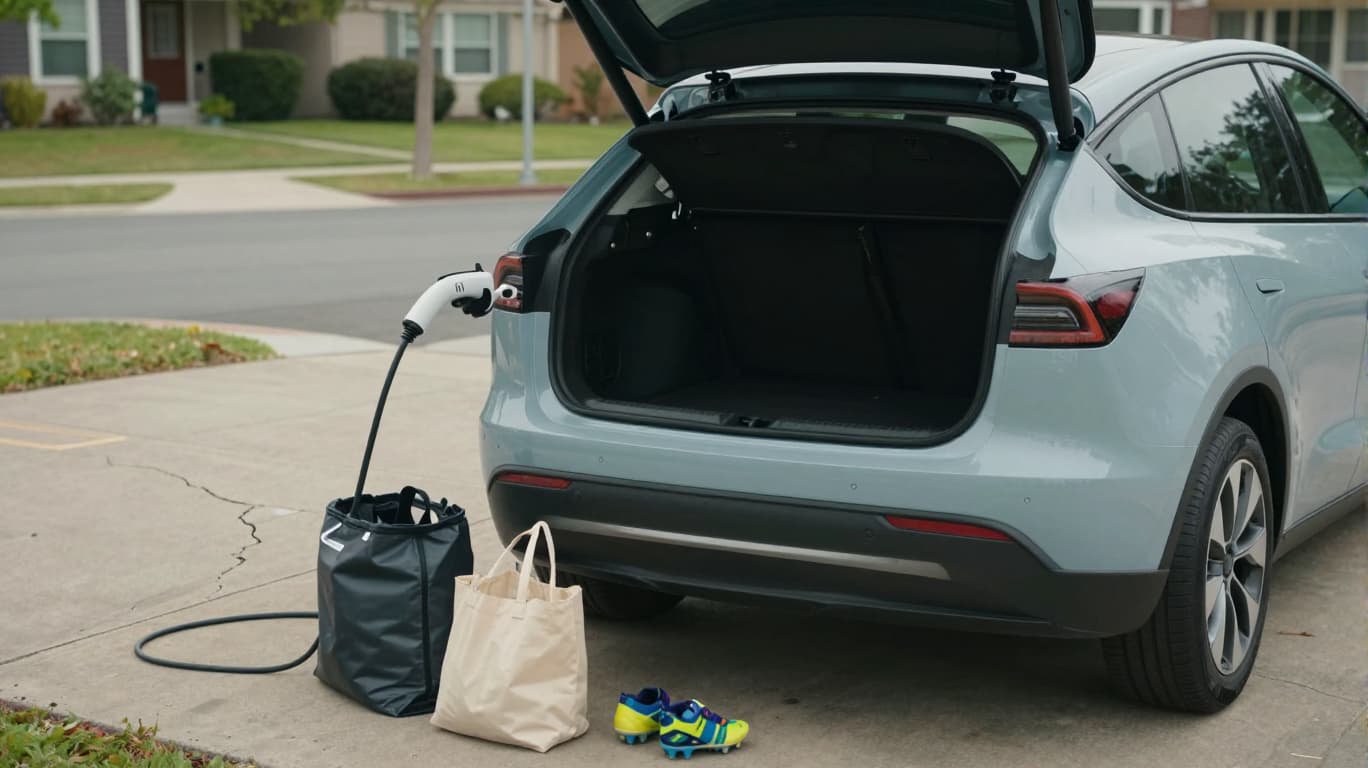
Bring your car seat to the dealership and install it. Bring your stroller and see whether the trunk closes. If you carry a dog, measure the cargo area with the dog in mind. If you play an instrument or haul tools or coach a sports team, those things need to fit.
A car that works for a solo driver with a briefcase might not work for a parent with a double stroller and a weekly grocery run. The spec sheet cannot answer this. Only loading your actual gear can.
What is the charging plan for the longest regular trip I take?
Every driver has a route they know by heart — the trip to visit family, the drive to a vacation spot, the work trip to a satellite office. For an EV buyer, that route needs a charging plan.
Open a charging app and map the route before you visit the dealership. See where the chargers are. See whether they are fast chargers or Level 2 units. Read recent reviews. Ask yourself whether the stop locations and durations would feel acceptable on a trip you make repeatedly.
Some routes are well served and the plan writes itself. Others have gaps that would turn a familiar trip into a logistics exercise. Knowing which category your route falls into before you sign a purchase agreement is the difference between informed confidence and unpleasant surprise.
What happens if the charger is broken?
Public charging reliability has improved, but it is not perfect. A charger can be occupied. It can be broken. It can be slower than expected. The question is not whether this will happen, but what you will do when it does.
Drivers with home charging rarely face this problem in daily life. Drivers who rely on public charging face it more often. Before buying, know where the backup chargers are near your home, near your workplace, and along your frequent routes. A backup plan that adds ten minutes to a charging stop is a minor annoyance. A backup plan that strands you is a major stressor.
Can I afford the insurance, not just the car?
The purchase price of an EV is not the same as the cost of owning it. Insurance is the line item that surprises buyers most often.
Electric vehicles cost more to insure than comparable gasoline cars — sometimes by enough to offset a portion of the fuel savings. The reasons are higher repair costs, heavier vehicle weight, and the complexity of battery-related collision repairs.
Call your insurance company with a specific VIN before you buy. Get a real quote, not an estimate. The number might not change your decision, but it will keep your budget honest.
What happens to my routine in winter?
Cold weather reduces EV range, and the cabin heater draws additional power. A car that covers your commute comfortably in October might need more frequent charging in January.
If you charge at home, the adjustment is minor. You plug in a little more often, and you precondition the cabin while connected to the charger. If you rely on public charging, the winter adjustment is more significant because you are making more frequent stops in worse weather. Think about whether that fits your patience and your schedule before you commit.
The table below summarizes the key questions and the real-life factors they uncover.
Question to ask | What it reveals |
|---|---|
Where will the car be parked and charged? | Whether your living situation supports an EV without major lifestyle changes |
How many miles do I actually drive each day? | Whether the range you need matches the range you are paying for |
What gear needs to come with me every day? | Whether the cargo space fits your family, work, or hobby equipment |
What is the charging plan for my longest regular trip? | Whether the charging network covers the routes you actually use |
What is my backup plan for a broken or occupied charger? | Whether you have the margin to handle infrastructure gaps calmly |
Can I afford the insurance, not just the car? | Whether the total cost of ownership still works for your budget |
What changes in winter, and am I okay with that? | Whether cold-weather adjustments feel manageable or frustrating |
The question behind all the questions
There is one question that sits underneath everything else Owen recommends, and it is this: "Am I buying this car for the life I actually have, or the life I imagine I might live?"
A car that fits your actual life — your real parking situation, your real commute, your real family configuration, your real patience for planning — will settle into your routine and stop demanding attention. A car that fits an idealized version of your life will keep asking for adjustments you resent making.
The best EV is the one that fits your life without asking you to change your personality. The questions above are tools for figuring out whether the car you are considering can do exactly that. Answer them before the test drive. The test drive will feel different once you have.