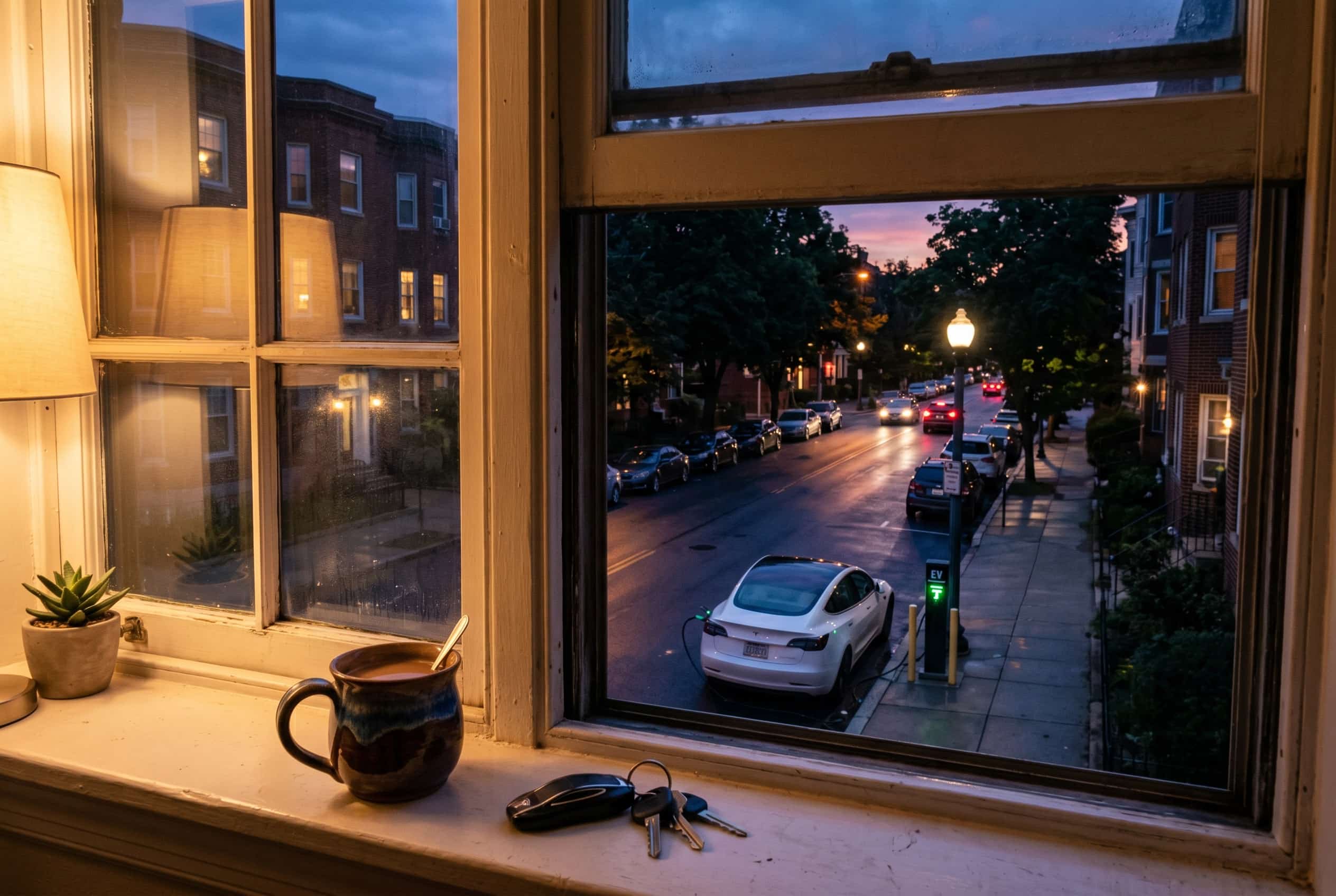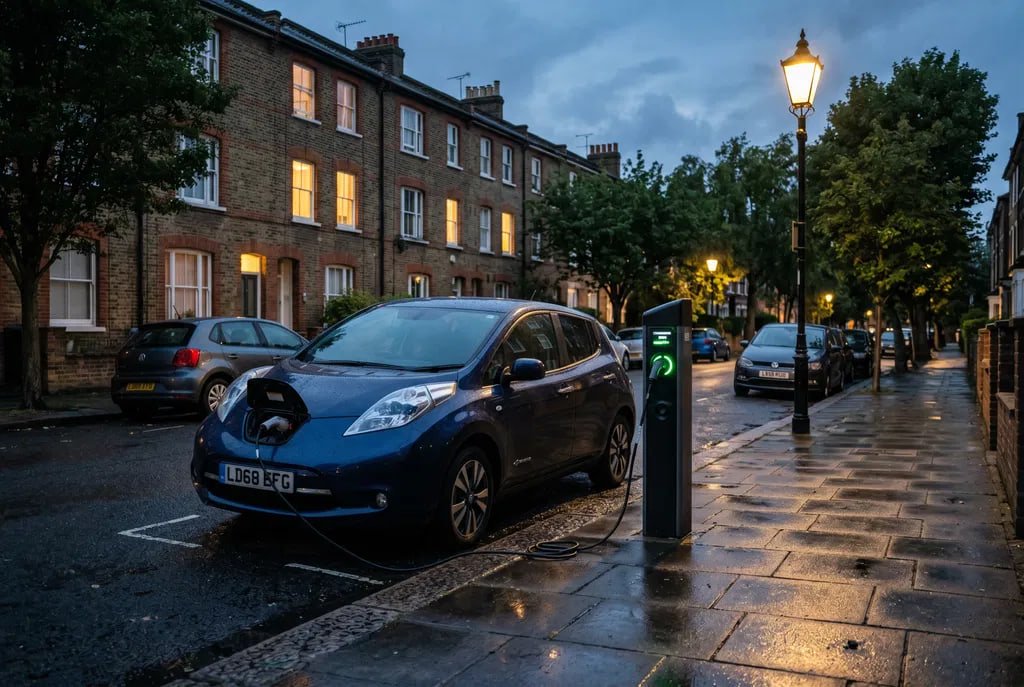
For a lot of Americans, the biggest barrier to buying an electric car is not the price. It is the parking situation. If you live in an apartment, a condo, a townhouse without a dedicated garage, or a single-family home where the driveway does not reach a power outlet, the standard EV advice — "just plug in at night" — does not apply to you.
Owen Barrett hears from readers in this situation constantly. The good news is that owning an EV without home charging is doable. The more honest news is that it requires more planning, more time, and a clear-eyed look at whether the tradeoffs actually work for your weekly routine.
The three charging options that replace a home charger
Without a plug in your garage or driveway, you rely on a mix of workplace charging, public DC fast charging, and public Level 2 charging. None is as convenient as plugging in overnight.
Workplace charging is the closest thing to a home-charging replacement. If your employer offers it, you can arrive, plug in, and leave with a full battery after a standard workday. Many employers subsidize the cost or offer it free. The catch is availability. As EV adoption grows, chargers can fill up by 8:30 a.m., and you depend on them being functioning and compatible.
Public DC fast charging can replenish a battery from 10 to 80 percent in twenty to forty minutes. It is the most expensive way to power an EV, often matching or exceeding gasoline per mile. Reliability remains inconsistent — chargers can be broken, blocked, or occupied. Used as a primary source, fast charging also stresses the battery more over time than slower charging.
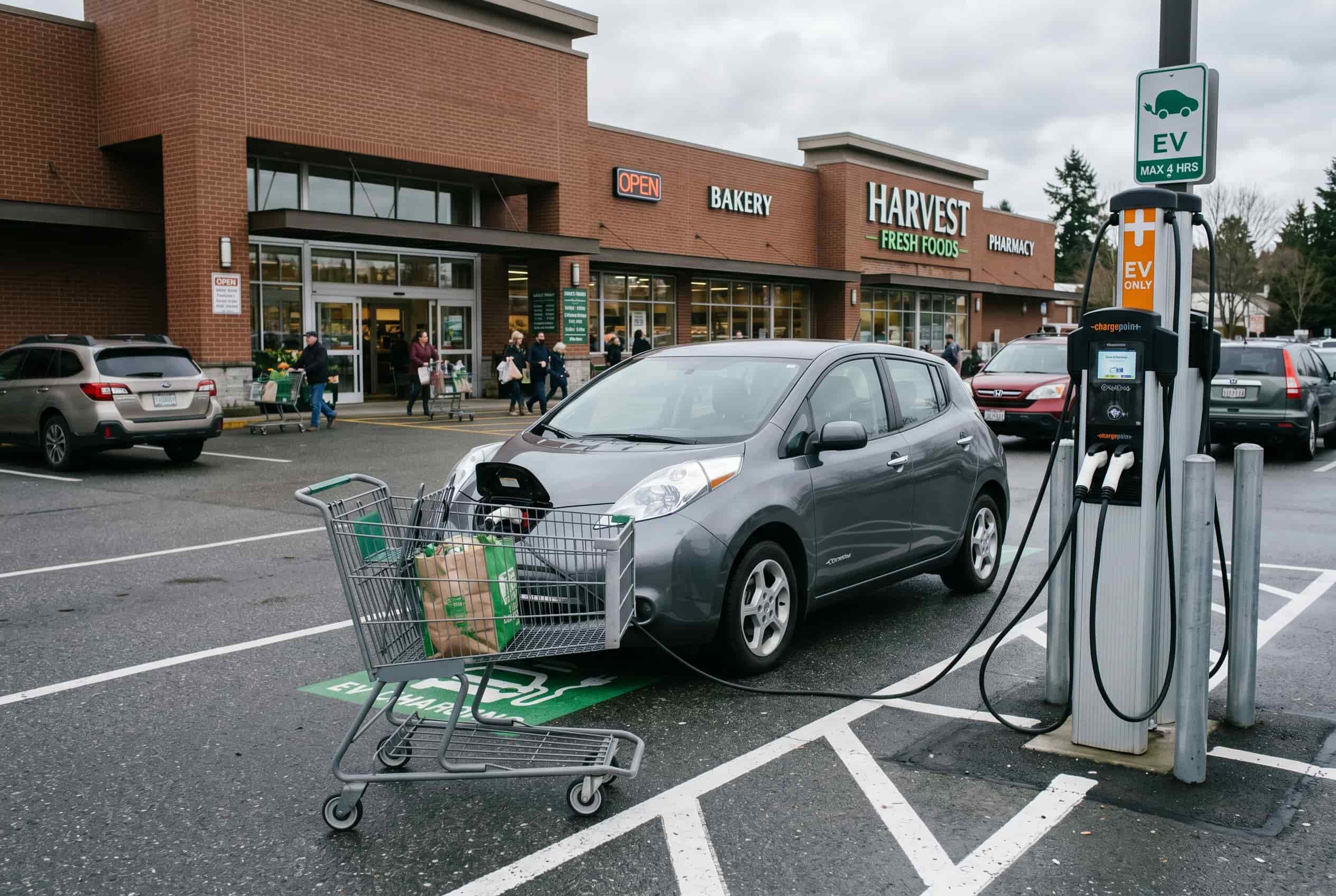
Public Level 2 charging is the kind found at grocery stores, libraries, parking garages, and shopping centers. It delivers twenty to thirty miles of range per hour plugged in. It is cheaper than fast charging and gentler on the battery, but requires weaving charging into errands. A grocery run becomes a charging opportunity. That works for some people and annoys others.
What the weekly routine actually looks like
The biggest adjustment is not the cost. It is how your week reorganizes itself around access to a plug.
A driver with home charging wakes up every morning to a full battery. A driver without it wakes up with whatever range was left over from the day before. The mental load of "where and when will I charge this week?" never fully goes away. It becomes a recurring to-do item rather than a set-it-and-forget-it habit.
The table below compares how the weekly routine shifts across different situations.
Living situation | Primary charging source | Weekly time commitment | Overall convenience |
|---|---|---|---|
Apartment with workplace charging | Office Level 2, supplemented by fast charging | Minimal; mostly passive during work hours | High, but dependent on employer availability |
Apartment without workplace charging | Public fast charging and Level 2 stations | Two to three dedicated stops per week | Moderate to low; requires consistent planning |
Rented house without off-street parking | Public Level 2 near home, occasional fast charging | Two to three sessions per week | Moderate; proximity of chargers is the deciding factor |
Condo with shared garage, no dedicated outlet | Public fast charging unless building installs shared chargers | Similar to apartment dwellers | Low to moderate, depending on HOA decisions |
For some, the routine becomes second nature. For others, it wears thin — especially in winter, when standing at a public charger in freezing weather is nothing like the cozy image of charging at home.
The cost picture changes without a home plug
The fuel-cost savings of an EV depend heavily on charging at home on a residential electricity rate. Remove that, and the per-mile cost rises noticeably.
Public fast charging is expensive. Even public Level 2 stations, while cheaper, often cost more than residential electricity. If you rely exclusively on public infrastructure, your per-mile fueling cost may be no better than driving an efficient hybrid. The lower maintenance costs and available tax credits can still help over a long ownership period, but the margin of savings shrinks — and in some high-cost regions, it disappears. Run the numbers with your local public charging rates, not the residential rate you wish you had.
Owning an EV without home charging works best when at least one of these conditions is true: you have reliable workplace charging, you live within walking distance of a dependable public Level 2 station, or you drive well under the car's maximum range each day and only need to charge once or twice a week.
It works less well when your daily mileage is high, your local public charging infrastructure is sparse or frequently broken, or your schedule has no flexibility. If your job requires unpredictable long-distance driving and you cannot guarantee a fast charger near your route, an EV without home charging becomes a logistical headache. In those cases, a plug-in hybrid or a highly efficient gasoline car is the more practical tool.
Questions to answer before you commit
Owen recommends answering four questions honestly before visiting a dealership.
First, where will I charge most often — and is that charger reliably available during my normal routine? Second, what is my backup plan if that charger is broken or occupied? Third, how much does public charging cost per mile in my area, and does the math still look good compared to a hybrid? Fourth, am I comfortable with the weekly time commitment of seeking out a charge, even on cold or rainy days?
If your answers feel steady rather than anxious, an EV without home charging is within reach. If the questions make you tense just thinking about them, it may be better to wait or to choose a vehicle that does not tether your daily mobility to a plug you do not control.
A car that fits your parking reality
The best EV is the one that fits your life without asking you to change your personality. For some, that means embracing the small logistical choreography of public charging because the car is quiet, quick, and cheaper to maintain. For others, it means admitting that without a driveway, the tradeoffs are too steep right now — and that is a perfectly reasonable conclusion.
No car should make your week harder than it needs to be. If an EV without home charging simplifies things for you, buy it with a plan. If it complicates things, give yourself permission to wait. Good ownership is mostly routine — and a routine you resent is not a routine you will keep.