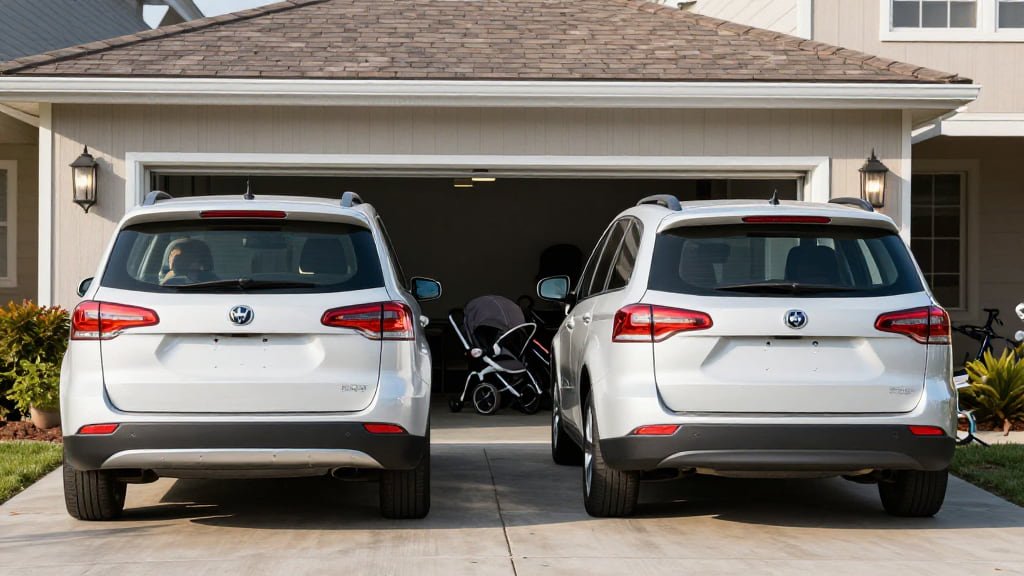
The family car is the least forgiving vehicle in a household. It handles the daycare drop-off, the grocery haul, the weekend soccer tournament three towns over, and the annual road trip to see grandparents. It carries car seats, sports equipment, spilled snacks, and occasionally a child who is loudly unhappy about being in a car at all.
The question Owen Barrett hears from parents is not "Is this EV impressive?" It is "Can this car handle my real life without making everything harder?" The answer, as with most things on this site, depends on what your real life actually looks like.
Car seats and cabin space: the test that matters
The first question for any family EV is not about battery range. It is about the back seat. Can you fit two car seats and still sit in the front without your knees touching the dashboard? Can a rear-facing infant seat fit without the front passenger seat being pushed all the way forward?
Some electric vehicles package their batteries under the floor, which raises the cabin floor and reduces vertical space. This can make rear-facing car seats a tighter squeeze than expected, even in crossovers that look spacious from the outside. Other EVs use the space well and offer rear-seat room that rivals or exceeds comparable gasoline cars.
The only way to know is to bring your actual car seat to a dealership and install it. Bring the stroller too, while you are at it. A test drive that does not include installing the gear you use every day is not a real test.
The table below compares how different vehicle layouts affect family usability.
Vehicle type | Car seat fit | Cargo with stroller | Family verdict |
|---|---|---|---|
Electric crossover (e.g., Kia Niro EV, Hyundai Kona Electric) | Good for one or two seats; tight with rear-facing infant seat behind a tall driver | Adequate; stroller fits but leaves limited extra space | Works well for families with one or two children |
Electric hatchback (e.g., Chevrolet Bolt) | Better than expected; upright roofline helps | Surprising cargo depth; large stroller may need to be folded compactly | Solid for a one-child family; tight for two children plus gear |
Electric sedan (e.g., Hyundai Ioniq 6) | Rear-facing seat may push front passenger forward uncomfortably | Trunk opening limits bulky items; stroller loading requires more planning | Better for families with older children in forward-facing seats |
Electric three-row SUV (e.g., Kia EV9) | Ample space for multiple car seats | Large cargo area even with third row up | Strong fit; higher purchase price is the main barrier |
The daily logistics: drop-offs, pickups, and the never-ending errands
The family car spends most of its life on short trips — school runs, grocery pickups, pediatrician appointments. This is actually where an EV shines. Short trips with frequent stops are the least efficient driving pattern for a gasoline engine, which never fully warms up and operates at its dirtiest and least economical in the first few minutes. An EV does not care. It is equally efficient on a two-mile trip and a twenty-mile trip. The cabin warms up fast. There is no engine idling in the carpool line.
The convenience of never stopping for gas with children in the car is also worth more than a spreadsheet can capture. A parent who charges at home avoids the scenario every parent dreads: a gas-station stop with a sleeping toddler in the back seat. The car fills up overnight. The morning starts with a full battery. One less errand in a week that already has too many.
The road-trip tradeoff: honest talk about family travel
Where a family EV requires more thought than a gasoline car is the road trip. This site has covered EV road trips in detail elsewhere, but the family-specific version is worth restating.
Charging stops on a family road trip are not necessarily a drawback. A stop every two to three hours aligns with how often young children need a bathroom break, a snack refill, or a chance to run in circles. The car charges while the kids burn energy. The tradeoff is that the stop is less flexible than a gas station. You stop where the chargers are, not where you feel like stopping. That might mean a travel center with a playground one time and a deserted parking lot behind a strip mall the next.
For families who take one or two road trips per year, the charging network in 2026 is developed enough that the experience is generally fine. For families who take long road trips monthly, a plug-in hybrid that offers electric daily driving and gasoline long-haul flexibility may be the more practical choice. There is no shame in that calculation. A car that fits your life is better than a car that fits an ideal.

The cargo equation: strollers, sports gear, and the stuff that accumulates
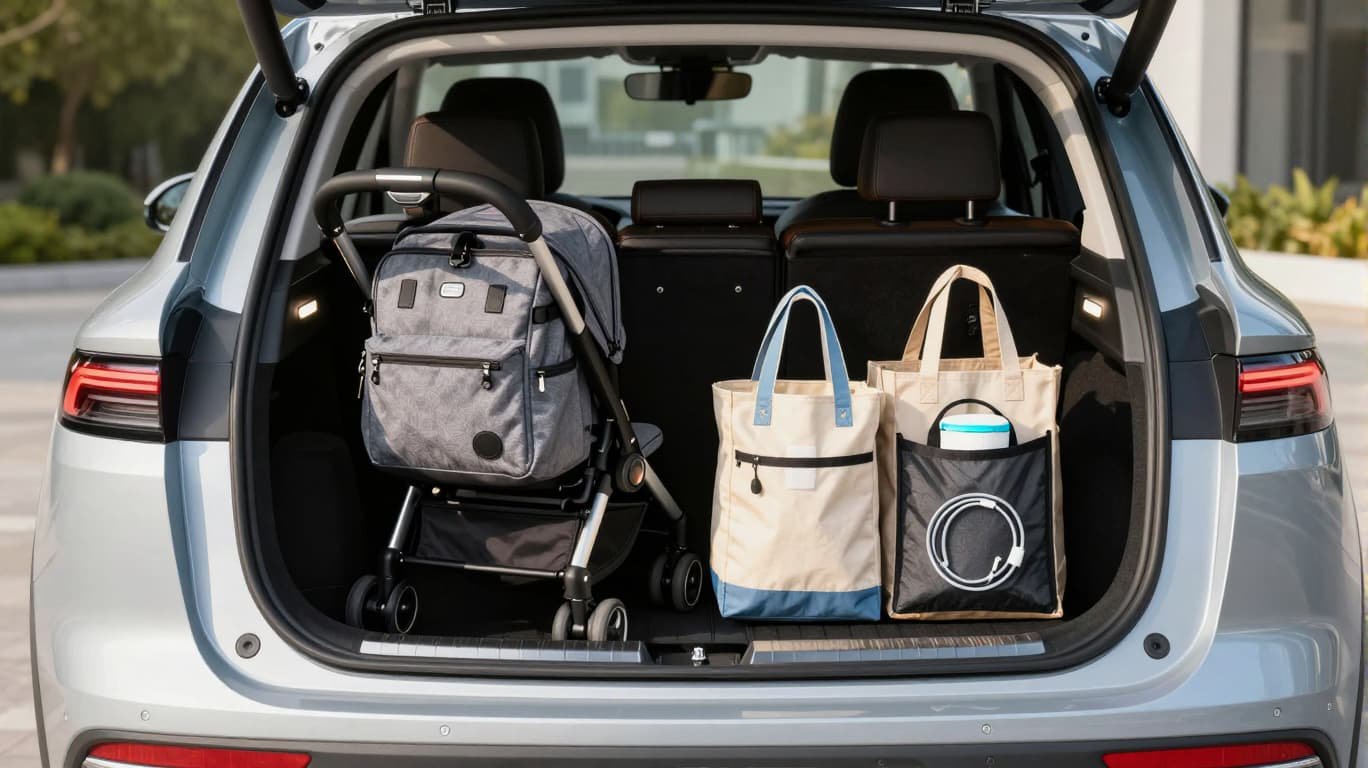
Children generate cargo. The stroller alone can consume most of a compact car's trunk. Add a diaper bag, groceries, and a portable potty, and the available space disappears fast.
Electric vehicles built on dedicated EV platforms often have an advantage here. Without a gasoline engine or transmission tunnel, the floor can be flatter and the center console storage larger. Some EVs offer a front trunk that is perfect for storing the charging cable or a small bag — items you do not want buried under the stroller.
The practical test is the same as with car seats: bring your gear to the dealership. Load the trunk with the stroller you actually own. See whether the cargo cover closes. Check whether the diaper bag fits behind the front seat where you can reach it. A car that feels spacious in an empty showroom can feel very different with a family's worth of belongings inside.
When the answer is not yet
For some families, an EV is the right answer right now. For others, the honest answer is not yet — or not this model. That is not a failure. It is a practical assessment, the kind that saves money and frustration.
If your family has three children in car seats, your vehicle options narrow considerably regardless of powertrain. If your family takes frequent road trips through rural charging deserts, a hybrid or plug-in hybrid may serve you better. If your family lives in an apartment without charging access, the logistics covered in earlier articles on this site apply doubly when children are involved — because the tolerance for added friction drops when you are already managing small humans.
The best family car is the one that makes your week easier, not the one that wins a technology argument. For a growing number of families, that car is electric. For some, it is still a hybrid or a gasoline vehicle. The adult move is to buy the one that fits your actual life.