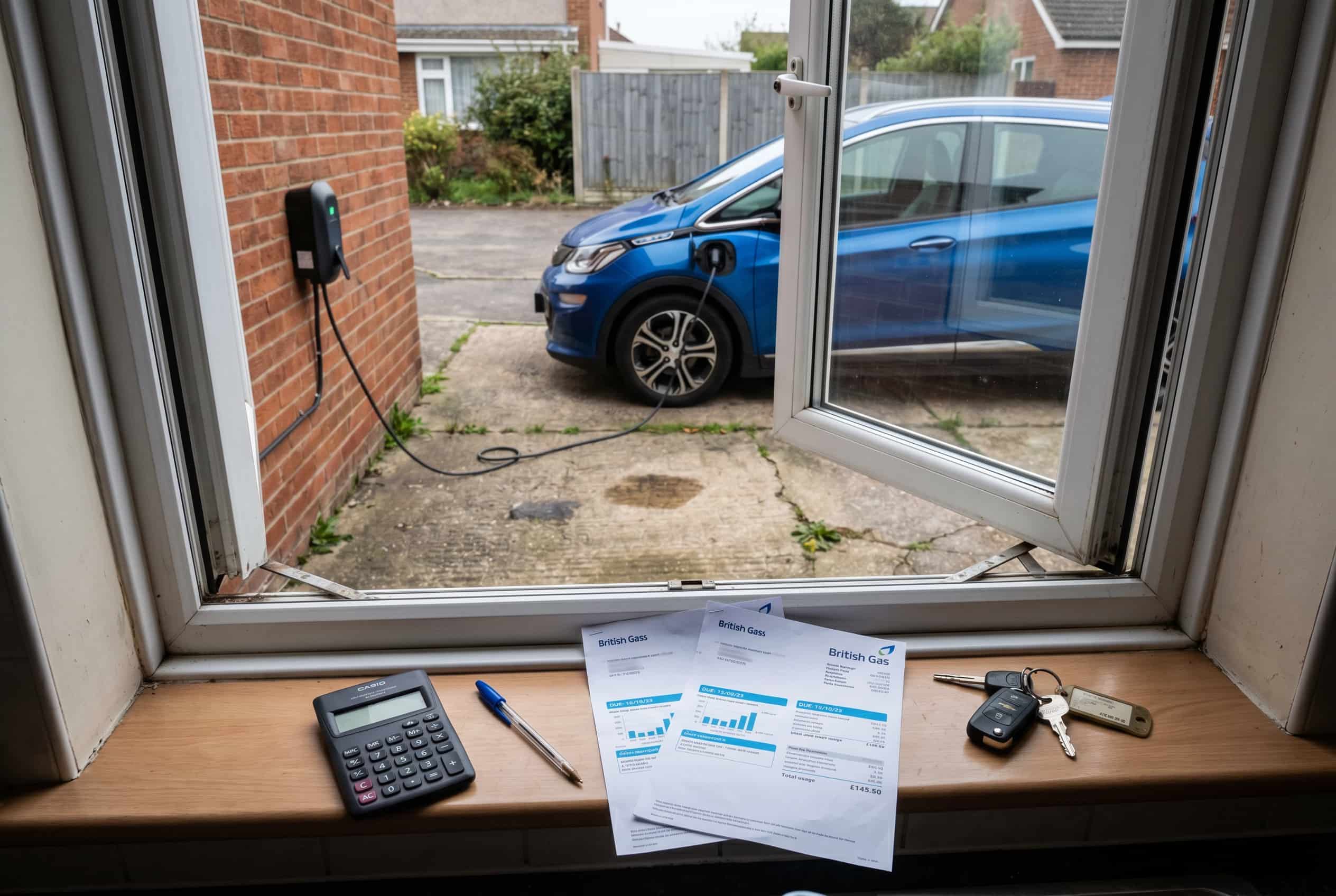
When someone asks Owen Barrett whether an electric car is worth the money, they usually mean one thing: will my bank account notice the difference every month?
It is a fair question. Gasoline is expensive, electricity looks cheap on a utility bill, and the advertisements promise thousands of dollars in fuel savings. The math seems obvious until you stop comparing sticker-price fuel economy and start looking at the costs that do not show up on a window sticker.
If your only reason for buying an EV is to save money, the honest answer is: it depends on things most buyers never calculate.
The simple math that is not actually simple
The most common savings argument works like this: electricity is cheaper than gasoline per mile, so an EV costs less to fuel. On average, that is true. In 2026, a typical American driver paying the national average residential electricity rate can expect to spend a moderate amount annually on home charging for twelve thousand miles of driving. A comparable gasoline car will cost noticeably more each year — the gap can reach several hundred dollars, which feels meaningful over time.
But that gap shrinks or disappears under several conditions that apply to millions of American households.
First, electricity rates vary enormously by region. In states with very high residential electricity prices, an efficient EV can cost roughly as much per mile to fuel as a hybrid sedan. The same is true if you rely heavily on public DC fast charging, where per-minute or per-kilowatt-hour pricing often pushes the per-mile cost above the equivalent gasoline number.
Second, the savings only accumulate if you drive enough miles. Someone who works from home and puts six thousand miles a year on the car may never earn back the price premium through fuel savings alone. The math rewards high-mileage drivers, not casual commuters.
The table below shows how the per-mile fueling cost comparison shifts under different conditions.
Scenario | EV fueling cost versus a 30 mpg gasoline car |
|---|---|
Home charging, average U.S. electricity rate | EV is significantly cheaper per mile |
Home charging, high-cost electricity state | EV and gasoline car are roughly equal per mile |
Public DC fast charging as primary fuel source | EV is often more expensive per mile than gasoline |
Gasoline car with unusually low fuel prices | Gasoline car is cheaper per mile than most EVs |

Insurance does not reset just because the car plugs in
The second biggest miscalculation Owen sees is insurance. Many first-time EV buyers assume their premium will stay roughly the same. That assumption is expensive.
Electric vehicles cost more to insure than comparable gasoline cars — typically fifteen to twenty-five percent more, according to 2026 industry averages. The reasons are not mysterious. EVs are heavier, repair parts are more expensive and harder to source, and even minor collisions can damage battery packs that cost thousands to replace. Some insurers also write off vehicles with battery damage that would be repairable on a gas car, pushing up total loss rates.
For a driver accustomed to a certain annual premium on a conventional sedan, the equivalent EV might add several hundred dollars per year — enough to erase a meaningful chunk of the fuel savings. The monthly increase alone can make the ownership budget tighter than expected, even before other costs enter the picture.
Before you commit, call your insurance company with a specific VIN and ask for a quote. Do not estimate. Get the real number. It may change the math faster than any electricity calculation.
Depreciation is a savings killer for short-term owners
The cost that most buyers ignore entirely is depreciation — the value the car loses between the day you buy it and the day you sell it.
Electric vehicles depreciate faster than gasoline cars as a category, though the gap is narrowing for some models. Several forces work against EV resale value. Technology improves quickly, so a three-year-old EV feels outdated in a way a three-year-old Camry does not. The federal tax credit effectively caps used prices because a buyer can get a credit off a used EV at a dealership, pushing down private-party values. And some buyers remain nervous about used battery life, which reduces demand.
If you buy a new EV and sell it after three years, you may absorb a depreciation hit that is significantly larger in percentage terms than what you would face with a comparable gasoline car. The difference can amount to thousands of dollars — more than enough to cancel out any fuel savings you accumulated during that short ownership window. The financial case for an EV gets stronger the longer you keep it. At six or eight years of ownership, the lower fuel and maintenance costs begin to outweigh the steeper initial depreciation.
Short-term thinking makes an EV look like a money-losing decision. Long-term thinking can make it work — but only if your life actually supports keeping the same car for the better part of a decade.
The charging equipment cost is real and often ignored
A final cost that first-time buyers overlo
ok is the charger itself. If you have a garage or driveway where you can install a Level 2 home charging station, you are looking at several hundred dollars for a quality charger plus installation costs that can vary from a few hundred to a couple thousand dollars, depending on your electrical panel location, its available capacity, and local permit requirements. Some older homes need a panel upgrade, which adds substantially to the total.
A federal tax credit covers a portion of the installation cost, but most households still face meaningful out-of-pocket spending. That upfront investment has to be factored into the total cost of ownership. If you save a few hundred dollars a year on fuel, it can take well over a year just to break even on the charger before you start saving anything at all.
For apartment dwellers or renters who cannot install home charging, the equation changes even further. Relying on public charging is more expensive and less convenient, and the per-mile cost advantage often disappears entirely, as the earlier table showed.
When an EV does save you meaningful money
None of this means an EV cannot save you money. Under the right conditions, it absolutely can. The problem is that many American households do not meet all of those conditions at the same time.
Here is the profile of a driver for whom an EV is a genuine long-term money saver: they live in a region with residential electricity rates well below the national average, they drive twelve thousand miles or more per year, they can charge at home on a Level 2 charger they already own or can install affordably, they qualify for the full federal tax credit at point of sale, and they plan to keep the vehicle for at least six years.
If that describes you, the savings are real and can reach several thousand dollars over the life of the car compared to a gasoline equivalent. If your situation differs on two or three of those variables, the financial case gets weaker quickly.
The table below summarizes the conditions that move the needle.
Factor | Saves money | Costs more or breaks even |
|---|---|---|
Home electricity rate | Below national average | Far above national average |
Annual mileage | Over twelve thousand miles | Under seven thousand miles |
Primary charging source | Level 2 home charging, overnight | Public fast charging as regular routine |
Ownership period | Six years or longer | Three years or fewer |
Federal tax credit eligibility | Full credit at point of sale | No credit or only partial credit |
Home charger installation | Simple, affordable install | Expensive install or panel upgrade needed |
The honest answer to the money question
Owen’s answer to the question “Is an EV worth it if I am just trying to save money?” is not the one an enthusiast forum will give you.
If you are a high-mileage driver with cheap home electricity, a tax credit in your pocket, and a plan to keep the car for a long time, the savings are real and worth pursuing. If you are a low-mileage driver in a high-electricity-cost state who would rely on public charging and might trade the car in after three years, you are more likely to lose money than save it. A hybrid or a fuel-efficient gasoline car may be the smarter financial move.
A car earns its place in the household not just through monthly payments, but through every cost it creates over the years you own it. An EV can be a good financial decision — but only when the numbers say so, not when the marketing does.