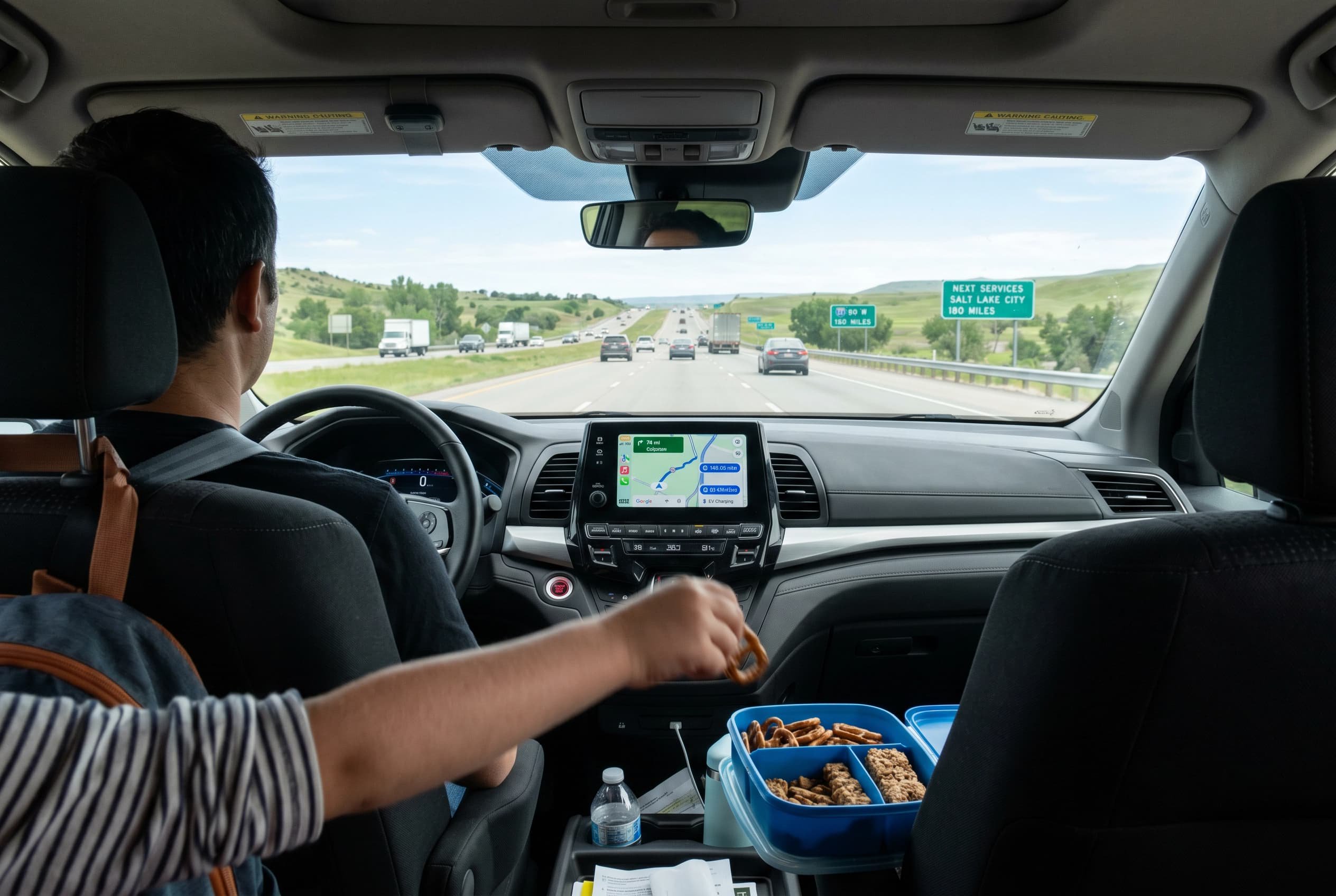
The road trip is the emotional center of America's EV skepticism. It does not matter that most driving happens within twenty miles of home. The question every curious buyer eventually asks is: "But what about when we drive to my in-laws for Thanksgiving?"
Owen Barrett has taken enough family EV road trips to know the answer is more practical than dramatic. An electric road trip with kids is not the effortless glide that some reviews describe. It is also not the anxiety-ridden disaster that critics predict. It is somewhere in between — and with honest planning, it works better than most people expect.
The planning is front-loaded, and that is the point
A gasoline road trip requires almost no advance planning. You get in the car, you drive, you stop when the tank is low. Gas stations are everywhere. The infrastructure is invisible because it is so dense.
An EV road trip asks you to think ahead. Not obsessively, but intentionally. You pick your route with charging stops in mind rather than assuming a station will appear when you need one. This sounds like a burden, but families who have done it several times report a counterintuitive finding: the planning forces a more realistic pace.
With a gasoline car, the temptation is to drive four or five hours straight, stopping only for fuel and bathroom breaks. With an EV and young children, the charging stops naturally break the trip into two-to-three-hour segments. Those segments happen to align with how long a six-year-old can sit still before needing to run around. The car's needs and the child's needs converge in a way that makes the trip less grueling, not more.
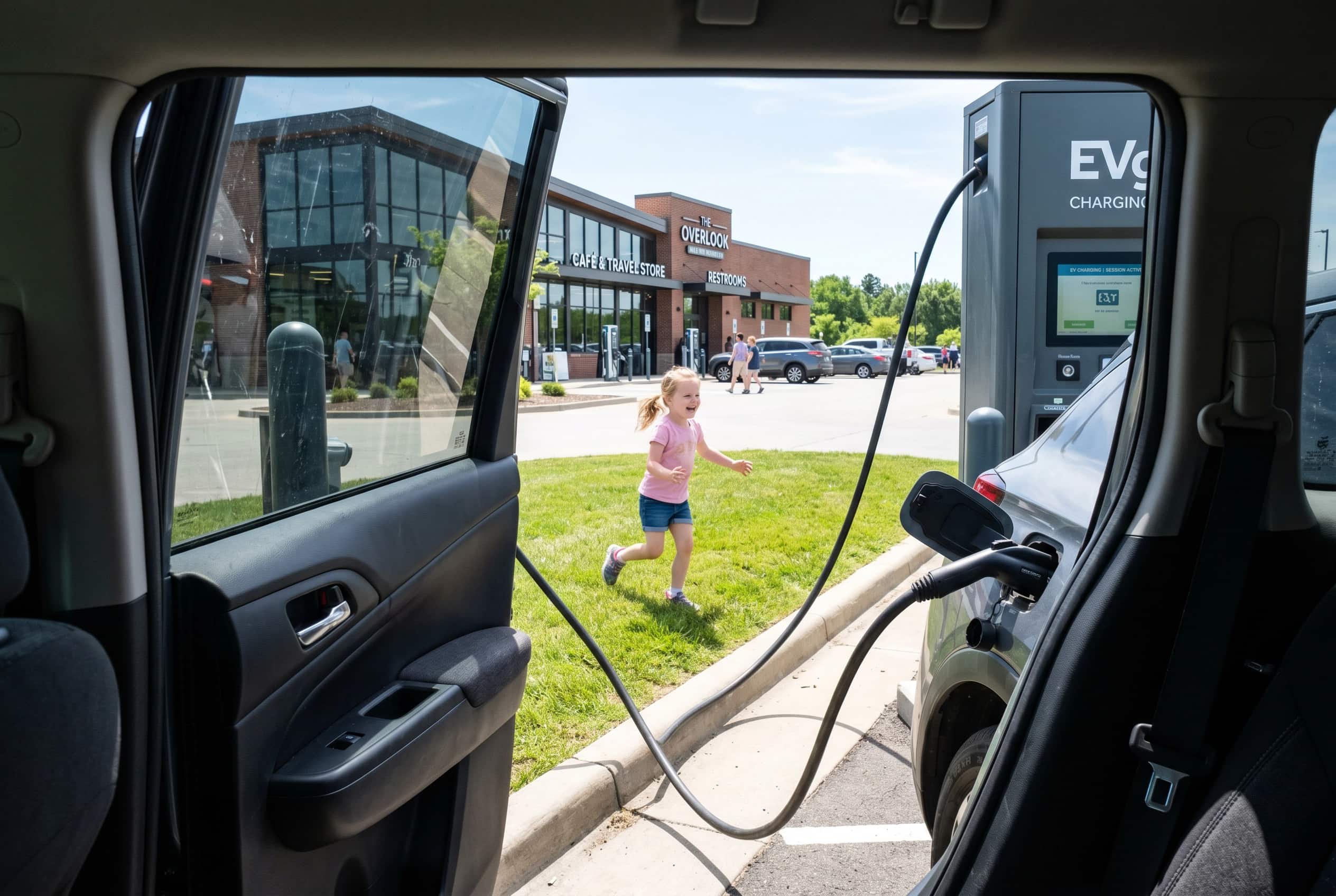
Owen's son Miles is a useful barometer. A charging stop that takes twenty to thirty minutes is exactly long enough for a bathroom break, a snack refill, and a few minutes of running in place. By the time everyone is back in their seats, the car has added enough range for the next leg. Nobody is watching the clock because the clock matches the natural rhythm of traveling with a small human.
The table below compares the pacing of a five-hundred-mile trip across different vehicle types.
Trip segment | Gasoline car (no kids) | Gasoline car (with young kids) | EV (with young kids) |
|---|---|---|---|
Typical driving block | 3-4 hours | 2-3 hours before demands for a stop | 2-3 hours between charging stops |
Stop duration | 10 minutes for fuel | 20-30 minutes for bathroom, snacks, movement | 20-35 minutes for charging, bathroom, snacks, movement |
Total stops, 500 miles | 1 fuel stop | 2-3 stops | 2-3 charging stops |
Arrival feeling | Tired, rushed | Tired, but kids were managed | Less tired, pace felt natural |
Charging stops are what you make of them
The quality of a family EV road trip depends more on the charging stops than the driving segments. A good stop has a clean bathroom, a place to buy snacks, and enough space for a child to move. A bad stop is a single fast charger in a deserted parking lot with nothing within walking distance.
In 2026, the charging networks have improved but are not uniform. Major highway corridors are well served. Rural routes still have gaps. Before a family trip, Owen checks not just where the chargers are, but what is next to them. A fast charger at a travel center with a playground or a grassy area is worth an extra ten minutes of driving. A fast charger behind a shuttered gas station is worth avoiding, even if it means adjusting the route.
Some families treat charging stops as mini-adventures. A thirty-minute stop near a small-town main street becomes a chance to walk, stretch legs, and find a local bakery. Others treat them as pit stops — efficient, unglamorous, and over quickly. Neither approach is wrong. The key is to know which type of traveler your family is before you leave the driveway.
The winter variable is real but manageable
Cold weather reduces range, and winter road trips require more careful planning. A route that takes two charging stops in July might need three in January. The cabin heater draws energy, and the battery's chemical efficiency drops in freezing temperatures.
The workaround is not complicated, but it requires honesty. Check the weather forecast along your route before departing. Add a margin to your estimated range. Know where the backup chargers are in case your primary stop is occupied or out of service. Precondition the cabin while plugged in at home and at each charging stop, so you leave with a warm car that has not already drained the battery.
Families who road-trip in winter learn to embrace the charging stop as a warm-up break. A travel center with hot chocolate and indoor seating turns a necessary stop into something closer to a rest. The car charges. The kids warm up. The trip continues.
One car seat, one charging cable, no drama
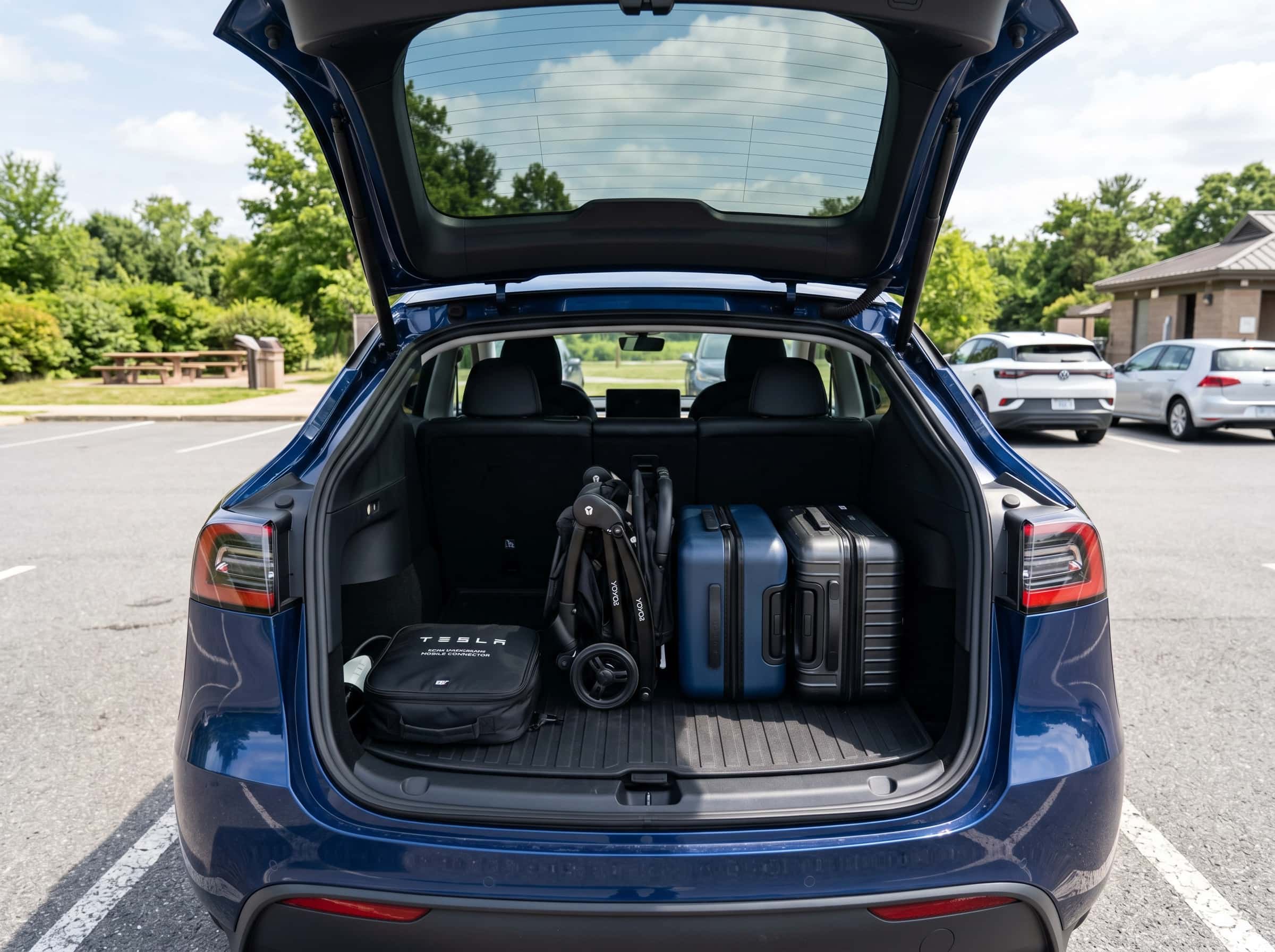
A detail that does not appear in most EV road trip reviews: charging cables and car seats occupy the same cargo-zone real estate. The portable charging cable that comes with most EVs is bulky. On a family trip where the trunk is already full of luggage, a stroller, and snack bags, the cable needs its own designated spot.
Owen learned this the hard way on his first family EV trip. The cable was buried under everything else at the first charging stop, requiring a full trunk reorganization in a rest-area parking lot. Now it rides in a dedicated bag in the front trunk or in the under-floor storage compartment, accessible without unloading anything. A small adjustment that saves a disproportionate amount of frustration.
When a hybrid still makes more sense
Honesty is the core of this site, and honest EV road trip advice requires acknowledging when an electric car is not the best tool for the job.
If your family takes frequent five-hundred-mile trips through rural areas with thin charging infrastructure, a plug-in hybrid may serve you better. You get electric driving for daily life and gasoline flexibility for long hauls. If you take one or two road trips per year and otherwise drive locally, the EV tradeoff is easier to justify — two days of planning per year is a small price for fifty weeks of home-charging convenience.
There is no universal right answer. There is only the answer that fits your family's actual travel pattern, not the one you imagine you might take someday.
The table below outlines which family profiles match well with a full EV for road trips and which might be better served by a hybrid.
Family profile | EV road trip fit | Notes |
|---|---|---|
One or two road trips per year, mostly highway corridors | Strong fit | Planning burden is minimal spread across a year of local electric driving |
Frequent long-distance trips through rural areas | Weaker fit | Infrastructure gaps add uncertainty; hybrid may be more practical |
Young children who need frequent stops anyway | Strong fit | Charging stops align naturally with kid-paced breaks |
Tight-schedule travelers who prioritize shortest total time | Weaker fit | Gasoline refueling is still faster; every stop matters |
Multi-car household with one gas vehicle available | Strong fit | Use the gas car for road trips, the EV for everything else |
The trip that changes your mind
Owen has a rule for first-time EV road trippers: take a short one before you take a long one. Drive somewhere two hours away, charge once, and come home. That single experience teaches you more about real-world range, charger reliability, and your family's travel tolerance than any article ever could.
Most families finish that first trip surprised. Not because the experience was perfect, but because it was normal. The car did what it was supposed to do. The stops felt less rushed than gas-station sprints. The kids were fine. The world did not end.
The best EV is the one that fits your life without asking you to change your personality. That includes your road-trip personality. If your family travels in a way that aligns with an EV's rhythm, you will enjoy the trip more than you expect. If your style is nonstop, pedal-down, get-there-as-fast-as-possible, an EV will frustrate you — and that is worth knowing before you own one.